
Selected Student Research
|
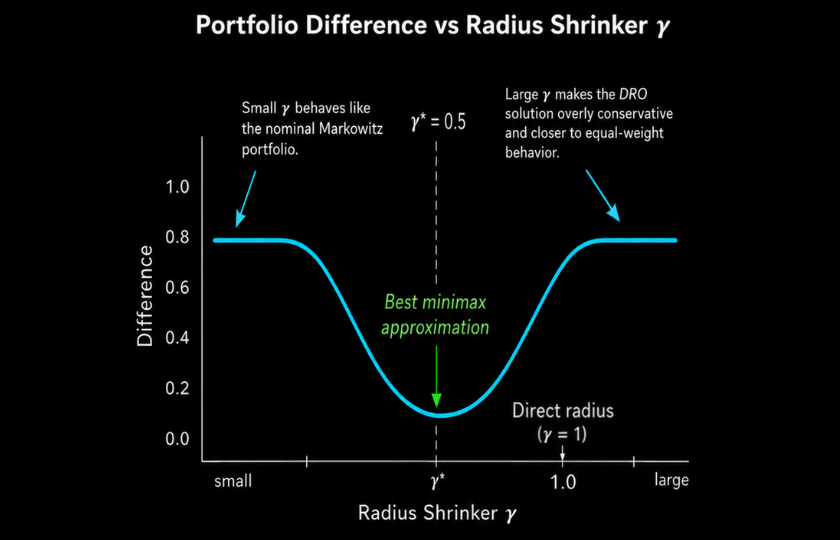
Comparing Box-Constrained and Wasserstein Ambiguity Sets in Robust Mean-Variance Portfolio OptimizationThis research investigates the application of a Wasserstein Distributionally Robust Optimization (DRO) framework to approximate a minimax robust portfolio optimization model under uncertainty in expected returns and covariance estimates. A split-radius approach is proposed to transfer uncertainty information from the minimax framework into the Wasserstein setting. Numerical experiments evaluate portfolio allocations, objective values, and computational efficiency. The findings show that the original Wasserstein radius produces overly conservative solutions, while an appropriately adjusted radius allows the DRO model to closely approximate the minimax benchmark with lower computational complexity. The study demonstrates the potential of Wasserstein DRO as an efficient approach for robust portfolio optimization under parameter uncertainty.
|
|
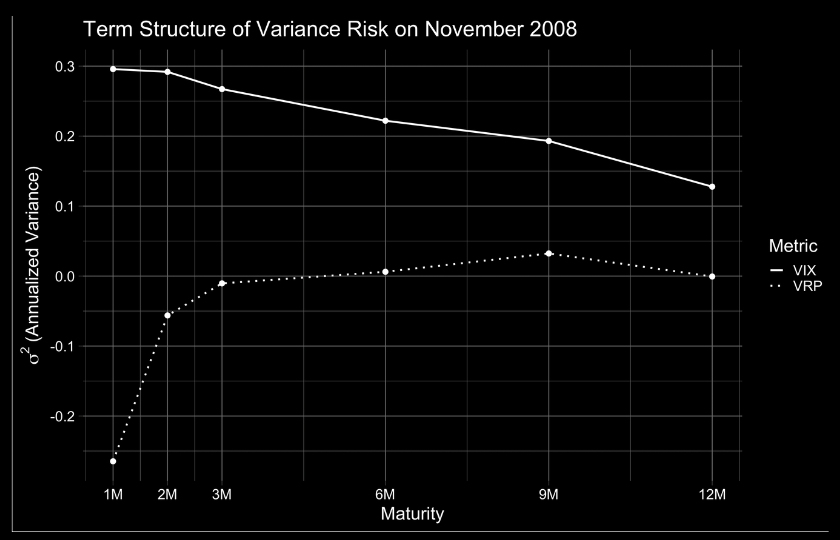
The Epidemic of Narratives and Variance Risk: How Information Uncertainty Explains Variance Expectations and PremiumsThis study demonstrates that uncertainty embedded within public news is an independent driver of the U.S. equity options market. Utilizing a comprehensive daily news dataset spanning 1996 to 2017, this research develops a framework that captures fluctuations in the information environment and extracts its underlying latent drivers to examine their relationship with the level and slope of the VIX and Variance Risk Premium (VRP) term structures. The empirical results reveal a fundamental structural dichotomy. The expectation-driven VIX responds to a broad spectrum of uncertainty reflected in public discourse, including political, speculative, and firm-level developments, whereas the insurance-driven VRP reacts primarily to a limited set of structurally transformative macroeconomic news that reshapes tail-risk expectations, such as changes in global trade and corporate restructurings. Finally, an out-of-sample hierarchical forecasting exercise demonstrates that information-based factors provide incremental predictive power for the VIX beyond its own historical dynamics and traditional macroeconomic predictors, such as the Treasury spread. In contrast, forecasting the variance risk premium continues to benefit from incorporating a broader set of macroeconomic indicators.
|
|
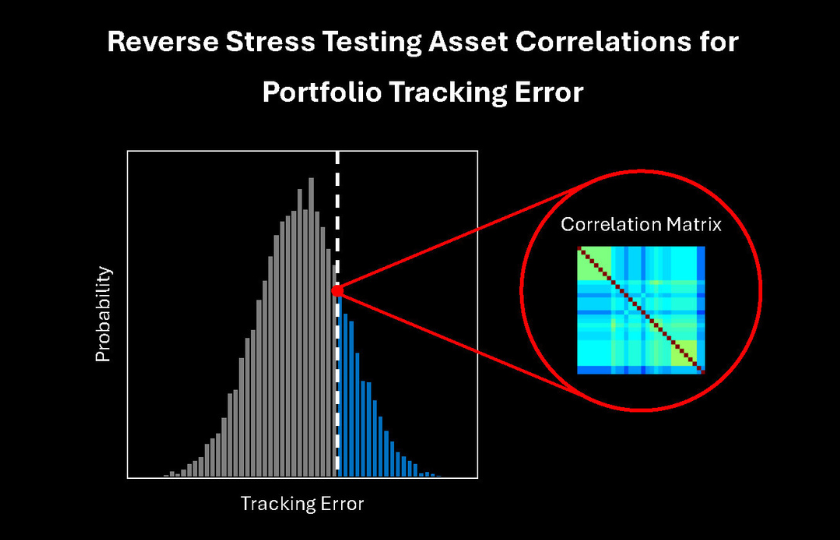
Reverse Stress Testing Correlations: A Reduced-Factor Model Framework for Analyzing Tracking ErrorThis thesis proposes a reduced-factor framework for Reverse Stress Testing (RST) that identifies the most probable asset correlation scenario causing a portfolio’s tracking error to exceed a predefined threshold while reducing computational complexity. Instead of including all economic drivers, the framework selects an optimal subset that closely replicates the stress scenario of a full model. Using Thai equity market data, the study compares the reduced and full models across different tracking error thresholds. Results show that retaining more drivers does not necessarily improve accuracy, and the reduced model requires recalibration when thresholds change substantially or on a quarterly basis. Overall, the proposed framework provides a computationally efficient and practical approach for portfolio managers to assess and anticipate correlation risk.
|
|
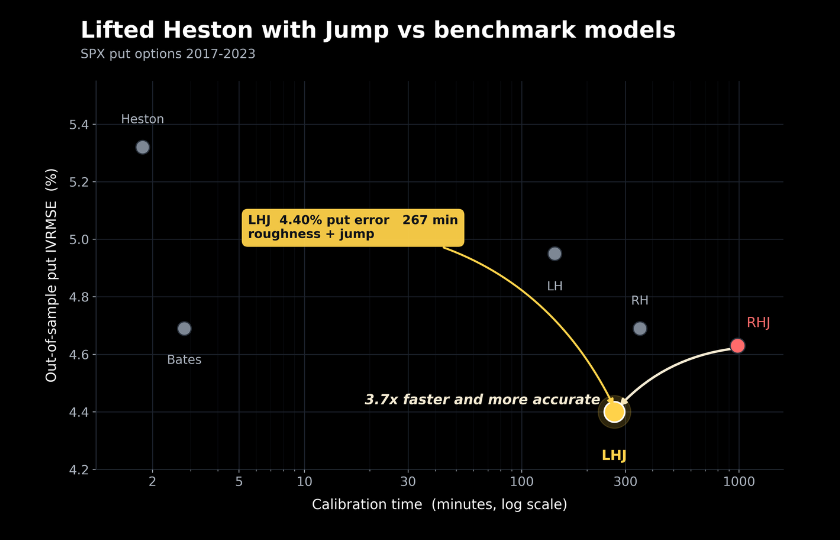
Option Pricing Under Lifted Heston Model with JumpThis thesis proposes the Lifted Heston model with Kou double-exponential jumps (LHJ), which combines the rough volatility behavior of the Lifted Heston model with asymmetric jump dynamics in a tractable Markovian framework. The model preserves the ability to reproduce the steep at-the-money implied volatility skew through rough volatility while capturing the short-maturity tail through jumps, with a closed-form moment generating function that enables efficient pricing. Using S&P 500 index options from 2017–2023, the model is compared with Heston, Bates, rough Heston, rough Heston with jumps, and Lifted Heston under a common calibration framework. Empirical results show that the proposed model achieves the best out-of-sample performance, reducing put pricing error to 4.40% compared with 4.63% for rough Heston with jumps, while requiring only 267 minutes of calibration versus 985 minutes. The improvement is most pronounced for downside options and during volatile market conditions, while maintaining competitive accuracy on call options. Overall, the Lifted Heston model with jumps provides a practical balance between pricing accuracy, computational efficiency, and the ability to capture both rough volatility and jump risk.
|
|
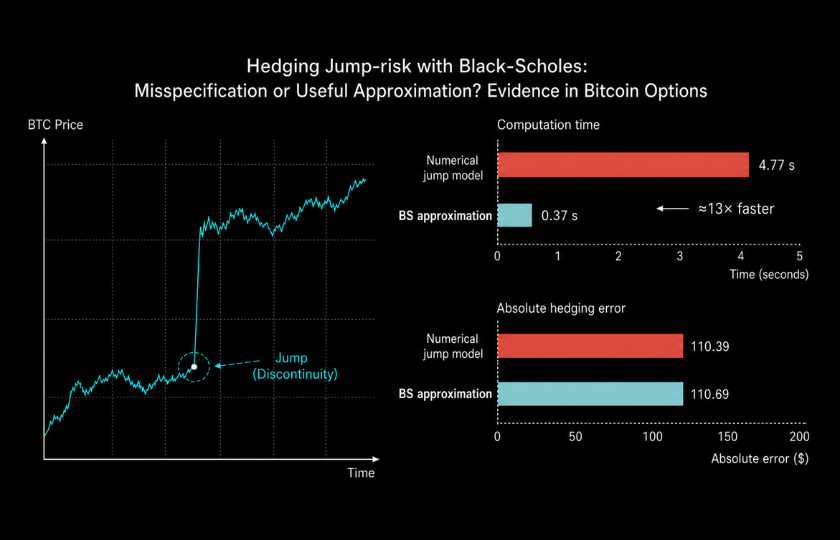
Hedging Jump-risk with Black-Scholes: Misspecification or Useful Approximation? Evidence in Bitcoin OptionsThis thesis proposes a computationally efficient jump-risk minimization framework for cryptocurrency options by combining model-consistent jump parameter estimation with analytical Black–Scholes pricing. The framework extracts jump parameters through MCMC calibration from advanced jump-diffusion models while replacing computationally intensive pricing equations with closed-form Black–Scholes solutions during optimization. Using out-of-sample backtests on the Deribit Bitcoin options market, the proposed approach significantly reduces execution time without sacrificing hedging performance. The results show that the primary source of improved risk reduction is the adoption of a jump-risk minimization framework rather than increased model complexity, while a broader set of hedging instruments further reduces tail risk and portfolio turnover.
|